Greenhouse Gas and VMT Mapped for Entire US

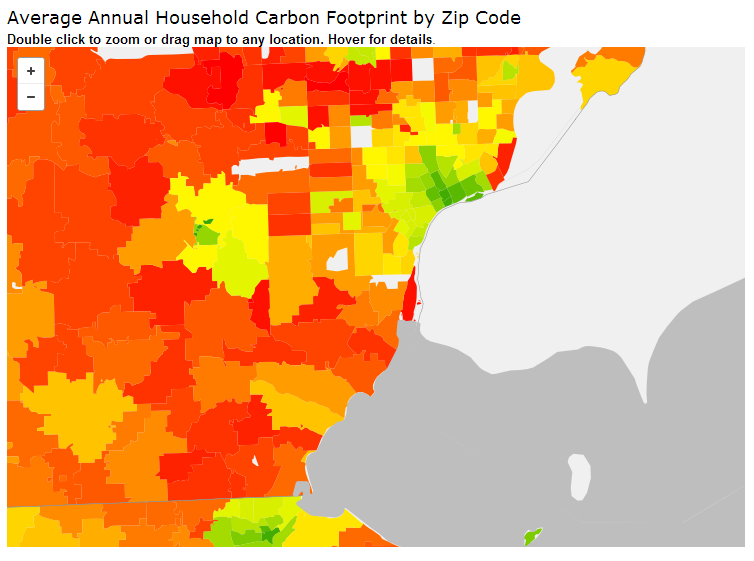
The CoolClimate Network at UC Berkely recently published some interesting maps that highlight Greenhouse Gas Emissions and Vehicle Miles Traveled for all US zipcodes.  The team behind the study wanted to find out which municipalities and locations within the United States contribute the most to household greenhouse gas emissions, and what is the effect of population density and suburbanization on emissions?

The models they developed, based off national household surveys, consistently found lower Household Carbon Footprint (HCF) in urban core areas and higher in outlying suburbs.  However, the relationship between population density and HCF was weak until reaching a certain density threshold.  The team concluded:

"Differences in the size, composition, and location of household carbon footprints suggest the need for tailoring of greenhouse gas mitigation efforts to different populations."

Below, we've included some screenshots from Washtenaw County.  For more information, view the maps at the CoolClimate Network website.
Annual Carbon Emissions.png
Annual VMT.png

MDOT Economic Impact of Bicycling Study

Student Bike Shop in Ann Arbor, Photo Credit: Andy Piper on Flickr

Student Bike Shop in Ann Arbor, Photo Credit: Andy Piper on Flickr

The Michigan Department of Transportation (MDOT) is conducting a study assessing the economic impacts of transportation choices throughout the state. Along with a study team consisting of BBC Research & Consulting and Rory Neuner Consulting, MDOT is interested in learning more about the transportation choices and related spending habits of Michigan residents. MDOT would appreciate your feedback and involvement.  Click this link or the title of this post to view and take the survey.

Very Cool Map Projection Website

London based data-visualization consultant Jason Davies put together an impressive site that animates many common and uncommon map projections.  For those uninitiated to map geekery, projections attempt to solve the flattening an orange peel issue, representing a 3 dimensional object on a 2 dimensional surface.  Flattening the earth results in portions of it skewing.  Projections account for the skew in different ways, sacrificing size, shape, and layout in various combinations to represent certain aspects of the globe. The beauty of Davies' animations is that they make the skew of the earth obvious as the globe rotates.  See some of our favorite projections below!

Visit the Map Projection Transitions website to see the animations and explore other projections!

Mythbusters on Roundabouts

The American 4 Way Stop Sign Vs The UK/ European Roundabout in how efficient they are with amount of traffic flow It Can Take. Mythbusters.

Mythbusters, a favorite show of at least one WATS staffer, recently asked if roundabouts are as fast and safe as traffic engineers and planners claim.  Watch the video above to see the results!

Obligated Projects List is Available

Every year, WATS publishes a list of all the completed transportation projects in Washtenaw County, the Obligated Projects list.  The FY 2013 obligated projects list is available, and can be accessed at this link.

In FY 2013, $46.2 million was obligated in Washtenaw County for highway, local road, bicycle and  pedestrian facilities, public transit and safety projects.  Of this amount, $12.2 million were Surface Transportation Program funds, which account for $9.4 million for urban programs, $1.7 million for rural programs, and $1.1 million of MDOT programs.  Congestion Mitigation Air Quality improvements provided $3.2 million directly and partially to Washtenaw County.

Map of Washtenaw County's Obligated Transportation Projects from FY 2013

Excellent Video from Ann Arbor Connector

The Connector is a developing plan for high-capacity transit in an arc from northeast to south Ann Arbor, connecting major destinations including downtown, University of Michigan campuses and medical center, and commercial areas.

In the map below, the crescent-shaped region represents the area being studied for The Connector. (Click the map to view a larger image.)

Over the next 18 months The Connector project will be conducting an Alternatives Analysis, the results of which will be a choice between four different transit alternatives – bus, bus rapid transit, light rail transit, and automated guideway transit – that will determine the future course of project development.  The study is managed as a collaborative effort of the AAATA, the City of Ann Arbor, the Ann Arbor Downtown Development Authority (DDA) and the University of Michigan (UM) and will also be closely coordinated with the Washtenaw Area Transportation Study (WATS), the Southeastern Michigan Council of Governments (SEMCOG), and the Michigan Department of Transportation (MDOT).

Comment on WATS' 2014/2015 Work Program

WATS' Draft FY 2014/2015 Unified Planning Work Program is available for comment. The UWP guides WATS’ and TheRide's federally funded planning efforts. WATS encourages the public to comment on the draft document, which will be approved pending comment at the January 15, 2014 Policy Committee meeting.  Click here for the Draft UWP, or here to view our Administrative Budget.  View the full list of WATS' UWP's here.

New WATS Website

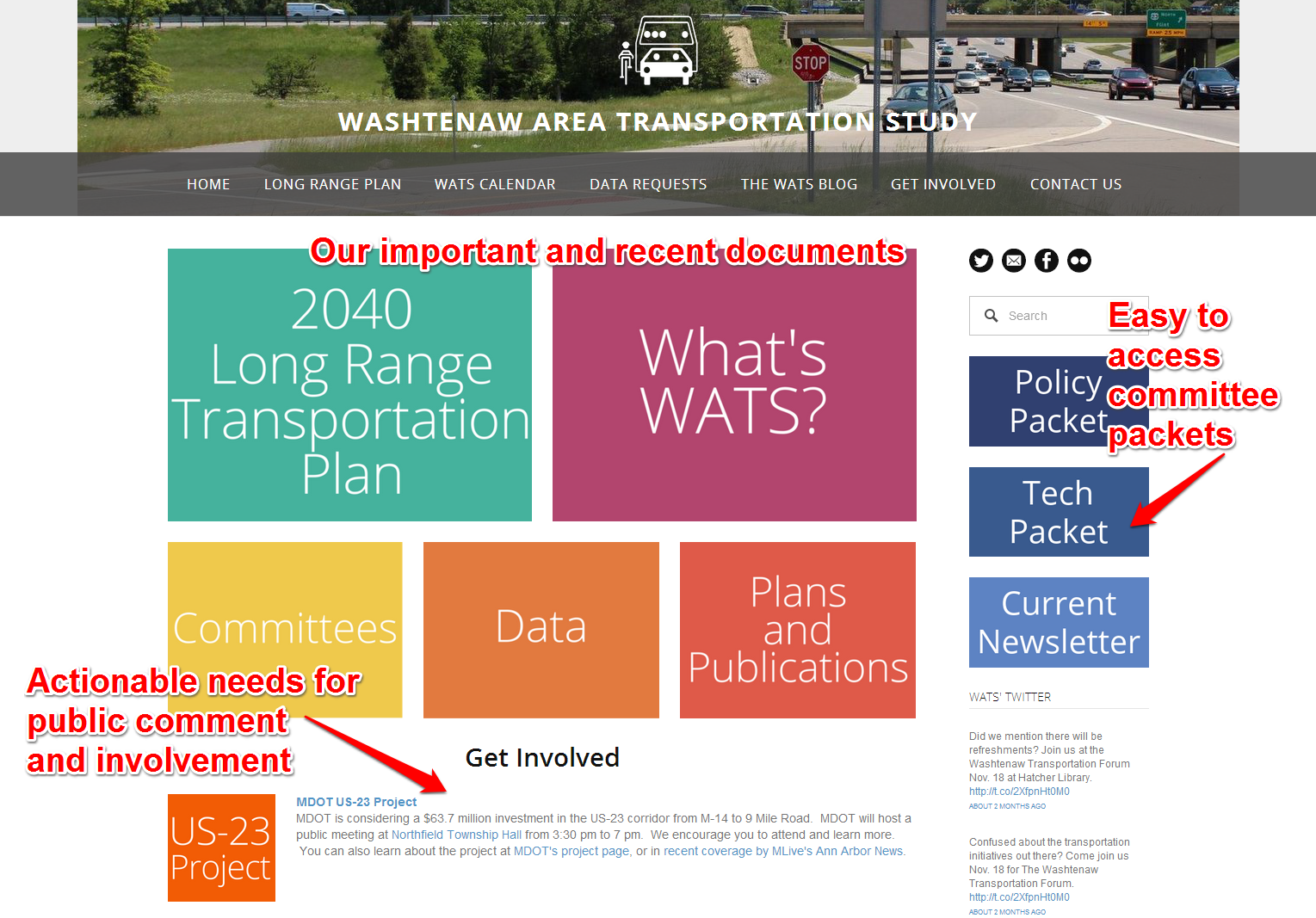
WATS is rolling out a redesign of its website!  The new design attempts to simplify access to important documents for the public and local elected officials.  View a screenshot and markup of the new homepage below.  

homepage screenshot.png

The design will allow us to highlight what opportunities are available for public participation, and will integrate the blog into the site as well.  WATS will continue to crosspost to the old blog at Blogger.

Since the new website was designed and created by WATS staff, if you have any thoughts or comments, we would be happy to consider integrating them.  We hope you like the new site, and are excited about the opportunities that a enhanced yet simplified web presence provides.

Visit www.miwats.org to see the new site.  If it doesn't display yet, check back in a day or two!

MDOT seeks public comment on draft 2014-2018 transportation program

MDOT banner 9-16-13 update.jpg

The Michigan Department of Transportation (MDOT) is seeking public comment on its draft 2014-2018 Five-Year Transportation Program. The draft document includes information about MDOT's funding picture and a list of specific transportation projects planned for the next five years in each of MDOT's seven regions. You can view the location, description and proposed construction year of upcoming MDOT projects on an interactive map online at www.michigan.gov/mdot5yearplan.

The Five-Year Transportation Program creates a continuous, interactive dialogue with the users of the state transportation system and anchors MDOT's project development and delivery systems. An integrated, multi-modal program that emphasizes system preservation and safety, it carries out the goals and policies outlined by the State Transportation Commission (STC). In addition to providing a list of MDOT-managed road and bridge projects, the document addresses investment strategies, funding assumptions, and economic benefits and impacts for all modes of transportation in Michigan, including highways, public transit, rail, air, marine and nonmotorized transportation.

MDOT presented the draft 2014-2018 Five-Year Transportation Program to the STC on Dec. 5, 2013. It will remain a draft program until it receives final approval by the STC in January 2014. The full document is available on the MDOT Web site at www.michigan.gov/mdot5yearplan.

Comments will be accepted until Friday, Jan. 10, and should be directed to Bob Parsons, Public Involvement and Hearings Officer, Bureau of Highways, Michigan Department of Transportation, P.O. Box 30050, Lansing, MI 48909; fax: 517-373-9255; or e-mail: MDOT-Five-Year-Program@michigan.gov. Alternative formats, such as print, large type and language translation, are available upon request by contacting MDOT's Public Involvement and Hearings Officer.

Transportation Inventions: The Invisible Bike Helmet

Two Swedish inventors, Anna Haupt and Terese Alstin, may have found a way to encourage self conscious cyclists to protect themselves.  Their Invisible Bike Helmet, Hovding, will protect cyclists in case of a crash by inflating quickly like an airbag around their head.  The inventors hope it will encourage more widespread helmet use, and make helmet-hair less of an issue for commuters.  Watch the video above to learn more!