New SMART Report Explores Mileage Based Vehicle Fees

A new report from SMART, the Sustainable Mobility & Accessibility Research & Transformation, explores and explains options related to a potential mileage fee for Michigan road funding.  Mileage fees are distance-based fees levied on motorists for use of a defined network of roadways. In other words, they are a simple market-based fee for service.

According to the report a mileage fee has a number of other advantages. It can:

  • improve transportation efficiency and access,
  • reconcile transportation funding shortages,
  • increase public and institutional cost effectiveness and accountability,
  • address institutional waste, and
  • support environmental sustainability.

The report from SMART includes:

  • potential economic, social and environmental benefits and challenges;
  • practical options for data collection and fee collection;
  • financing models and potential costs; and
  • implementation and phasing options and strategies.

As the legislature begins considering strategies for improving the experiences of Michigan drivers, passengers, cyclists, and pedestrians; this report provides an intriguing and innovative perspective on transportation funding.  Challenges remain for implementing a mileage based solution, most notably privacy, but the prospect of a well funded transportation system based on use is worthy of exploration.  For more information, view the SMART report, or read coverage of the report from the Detroit Free Press.

SMART is a multi-disciplinary initiative of the University of Michigan that undertakes and catalyzes research, tech transfer (living labs), education, and global learning exchange on a range of issues related to transportation’s role in a sustainable future locally and globally.
Take the Share the Road Safety Pledge

A sign with a bike and car above another sign that says 'Share Michigan Roads'

Bicyclists are involved in less than 1% of all traffic crashes. Proportionally, however, they represent a greater number of fatalities than any other group of roadway users. This is why it is especially important for drivers to always pass bicyclists at a safe distance and yield to them before making turns.

Each year approximately 2000 bicyclists are injured in crashes in Michigan, with approximately 25 of these crashes resulting in fatalities. While engineering improvements implemented as a result of Complete Streets will help create a safer environment for bicyclists who use Michigan roads, more must be done in regards to education to help drivers better understand how to safely interact with bicyclists. 

The  Share MI Roads campaign seeks to reduce this number by creating an alliance between bicyclists and motorists to be more aware of each other on the roads, to obey all applicable traffic laws, and to respect one another as human beings.  

Click this link to take the Share MI Roads safety pledge and make your personal commitment to help make Michigan roadways safer and more comfortable for all users.

Share MI Roads is a campaign of the League of Michigan Bicyclist (LMB) in partnership with Transportation For Michigan (Trans4M).

ReImagine Washtenaw Corridor Improvement Study

Click the image to download the document

Click the image to download the document

“A multi-jurisdictional, cooperative initiative to TRANSFORM Washtenaw Avenue around efficient mass transit into an attractive, vibrant, walkable, mixed-use corridor, with sense of place."

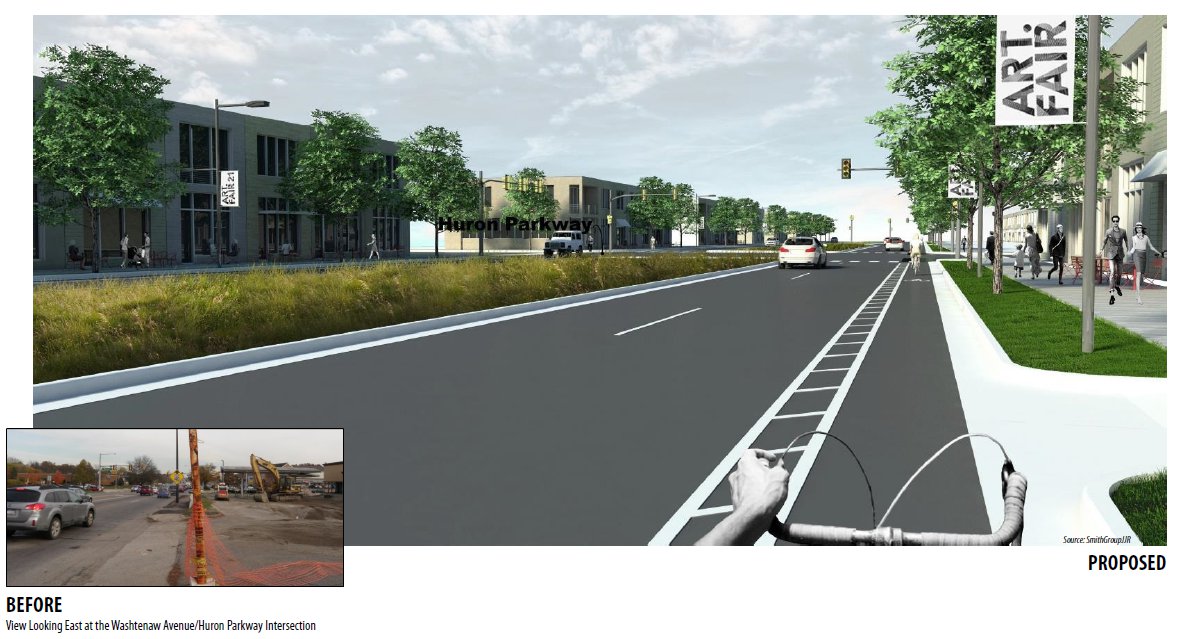
The ReImagine Washtenaw coalition recently released the final ReImagine Washtenaw Corridor Improvement Study, formerly known as the “Right-of-Way” study. This project was funded by the HUD Sustainable Communities Challenge Grant, which wraps up in January 2015. This work represents a step forward for ReImagine Washtenaw in creating a coherent cross-section plan for the future of the corridor. The plan provides the clearest understanding of how to achieve a multi-modal street, where reasonable accommodations are provided for, not only vehicular travel, but also pedestrians and bicyclists.

Specific goals of this corridor improvement study included:

  • Identifying the limits of the existing MDOT right-of-way.
  • Expand multi-modal transportation choices and increase user safety.
  • Improve the streetscape environment and non-motorized infrastructure.
  • Improve pedestrian safety at signalized intersections and proposed mid-block crossings.
  • Provide the potential for improved transit service and enhanced user experience.
  • Identify the extent of additional property required to implement the recommended improvements.
A possible multi-modal future for Washtenaw Ave.

A possible multi-modal future for Washtenaw Ave.

The study lays out a clear, dimensional plan for the future cross sections of each segment of the corridor. The plan calls for four, 11 ft. travel lanes and a middle left-turn lane (or median) throughout the entire length of the corridor. In addition, a continuous, eight (8) foot wide bike lane, including a three foot buffer, is planned as part of the future cross-section.

Given the important role that public transit will play in the economic redevelopment strategy for the corridor, careful planning was undertaken to find appropriate locations for bus stops with enhanced services and amenities, called “Super Transit Stops.” These stops will support continued  improvements to the transit service along the corridor, and are a necessary component to possible  future Bus Rapid Transit service along the corridor.

Click here to download and read the plan.

MDOT Sponsors Walking Audit of Washtenaw Avenue

On April 22, elected officials, planners and engineers assembled to perform an MDOT sponsored walking audit of Washtenaw Avenue in Pittsfield and Ypsilanti Townships.  Walkability audits are designed to help community officials and other stakeholders realize the benefits of providing a safe and attractive environment for walking.

MDOT’s audit team included renowned experts Peter Lagerway and Hannah Remtema.

The audit team faced a number of issues challenging pedestrians such as incomplete sidewalks, narrow separation from vehicles and a lack of safe crossing opportunities.  The results of the audit will help the Reimagine Washtenaw team as the project moves towards implementation.  In 2015 Community Development Block Grant funds will be used to fill in some of the sidewalk gaps that exist along the corridor.

Walking Audit Team


MLive Covers Upcoming ArborBike Bike Share

Map of stations around Downtown Ann Arbor and the University of Michigan Campus

A recent article on MLive's The Ann Arbor News covers the new Bike Share, ArborBike, from the Clean Energy Coalition.  The Bike Share is a joint partnership between the Clean Energy Coalition, University of Michigan, and the City of Ann Arbor.  Phase 1 of the program will include 125 bicycles at 14 stations in various locations around Downtown Ann Arbor and the University of Michigan.  According to MLive, the stations will begin rolling out in June of this year, and annual memberships will be $65.  Fore more information, check out the article on MLive.